
Ten ways to protect and enhance a child’s creativity in today’s tech world
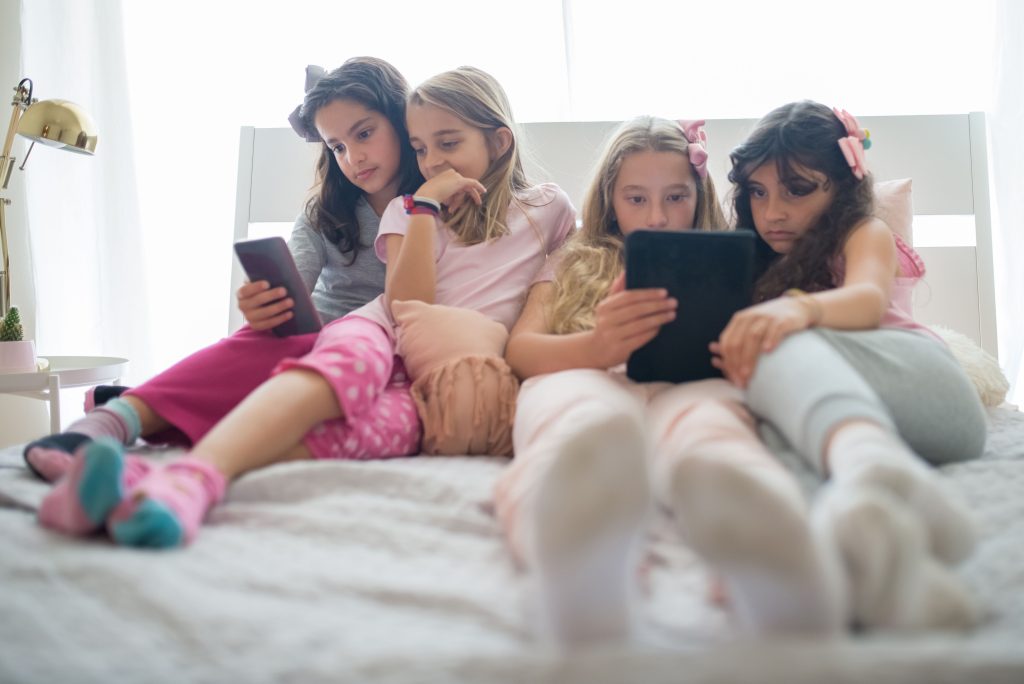
Photo courtesy of Kampus Production via Pexels
(Note: I was recently invited to contribute to a new handbook, C.O.D.E. (Conduct of Digital Etiquette), which will be published Aug. 31 this year. It will be used with media labs in classes 1-5, primarily in India. The editor, Pratap Somvanshi, who’s managing editor of the Hindustan Daily, asked that I write a piece that addresses how parents and teachers can protect and enhance a child’s creativity. He wrote: “You might draw upon your own experiences of how your creativity was nurtured, and contrast that with the unique challenges children face today in the age of AI.”
Well, I’m not a fan of AI and mostly endorse old-school methods of communication that don’t require digital screens. (Please note that I do not address many important issues related to online use and AI such as cyberbullying, deepfakes, safety from predators, the environmental impact of AI, etc. Other authors address that elsewhere in the book.) I wrote the following piece:
Long before the Internet existed, my mother read me bedtime stories. Classics like Treasure Island by Robert Louis Stevenson and White Fang by Jack London enthralled me with daring adventures and engaging, believable characters. As a reader or listener, I entered fictional, sensory worlds that felt as true and absorbing as what we call “reality.”
Inspired by such rich escapism and wanting to create my own stories, I tapped out overwrought tales on my mother’s typewriter at about age seven. Sure, my creations were cliché, but the possibility of life as a writer had already taken hold. I went on to become an author of picture books and adult nonfiction, a magazine and book editor, and a journalist.
The inflections of my mother’s voice as she read to me, her love and appreciation of the written word, and our weekly visits to our local library all helped instill in me a voracious desire to read and write. I still remember fondly the children’s story hours at the library, especially when we heard a librarian read from The Borrowers, a series of fantasy books by British author Mary Norton. We learned how a miniature human family of three lived under the floorboards of a regular-sized home and often borrowed their household items. A matchbox became a dresser and a postage stamp transformed into wall décor. Even today, I sometimes look at knickknacks in my home and imagine how the Borrowers might have used them.
What made this tiny family even more real for me, as a young library visitor, was the cardboard house that the children’s librarian created and displayed for us as she read aloud. She had cut out figures to represent the Borrowers and had included some small items they could use in their home.
Hence, a key factor in nurturing my creativity was direct, positive engagement with an adult. Nothing beats having a caring, mindful adult available, in person, to answer questions and provide praise, encouragement or suggestions. Such attention requires quality time and patience.
Compare this type of human contact with a child communicating with a bot via tablet or laptop. The latter is impersonal, contrived and limited by data input. It’s a poor substitute for real-life human expression, which honours in-the-moment individuality and uniqueness. Therefore, here’s the no-brainer first way to protect and enhance a child’s creativity:
1. Spend quality, in-person time with a young one, whether it’s reading to them aloud, playing, colouring or providing thoughtful answers to their questions. Do not involve any computers or cell phones.
I am not a fan of AI and bemoan today’s obsession with technology and social media. I support moves like Australia’s 2024 nation-wide ban on mobile phones in all public schools. However, as a realist, I recognize that the Internet, social media, and AI are here to stay. Like the impact of any communications medium, it all comes down to how you use it.
2. Limit the use of computers and mobile phones both at home and at school. Images and views expressed on social media, controlled by algorithms or appearing as “deepfakes,” shape your child’s identity, self-image, and cultural beliefs. This encourages blind conformity rather than building an authentic self. Therefore, it is wise to establish screen time limits and ground rules regarding how, when, and where your kids use their phones and/or tablets. Set good examples for them; don’t spend hours yourself in front of a screen at home every day. Teach your children to question what they see and hear. This builds creativity.
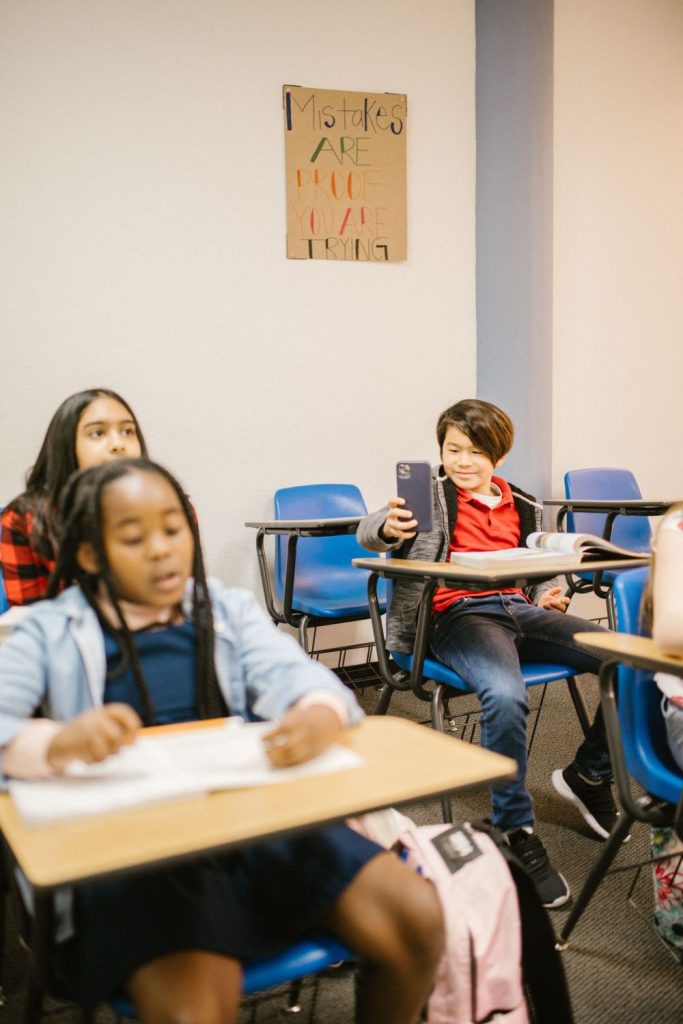
Photo courtesy of RDNE Stock via Pexels
3. Encourage regular visits to the library and finding answers from books. Nothing beats the tactile physicality of books in a child’s hands. Nowadays, a young one can ask ChatGPT a question and get instant research as a response – which is not always accurate. They don’t need to think (“cognitive offloading”) because it’s all there in one convenient summary. That is no way to learn. Instead, encourage children to explore and question multiple sources to find their own answers and think for themselves. That means visiting a library and seeking out diverse reading materials. A curious mind, which doesn’t accept everything on face value, is a core part of creativity.
4. Reinforce the power of storytelling. Tell your children stories about your life or ones you’ve heard or read about. Let them create their own aloud, even if they ramble and don’t make sense. This heightens the use of their imagination and is far more effective and original than “borrowing” unoriginal stories created by AI. Accept the power of myths, fables, and folk tales. Their events and characters encourage imagination, wonderment, and valuable life lessons. If they feel motivated, encourage children to write these stories down, either on paper or a computer. Person-to-person storytelling engages people more directly than just hearing or watching a story online.
5. Explain archetypes to children and give them examples from multiple sources. Archetypes are universal personality types or characters found in every culture, in myths, and stories, such as The Wise Mentor, The Rebel, The Wounded Child. Let kids explore and discover examples in their own and others’ lives, in their favourite stories, shows, and games.Helping children to recognize and understand these behaviour patterns expands their sense of self and helps them create connections to other races and cultures. It provides a diverse framework for creative storytelling and can enhance role-playing and fantasy games.
6. Provide a space and opportunity for children to do hands-on, paper or multimedia collage-making without any end goal. It’s easy for children to move shapes and images around on a screen, but that doesn’t engage them as directly as cutting and pasting from books, calendars and magazines. In the latter process, they search and choose the images they want to use; their choices don’t just magically appear on a screen. No specific goal or theme is needed. Just let kids experiment and create something that appeals to them.
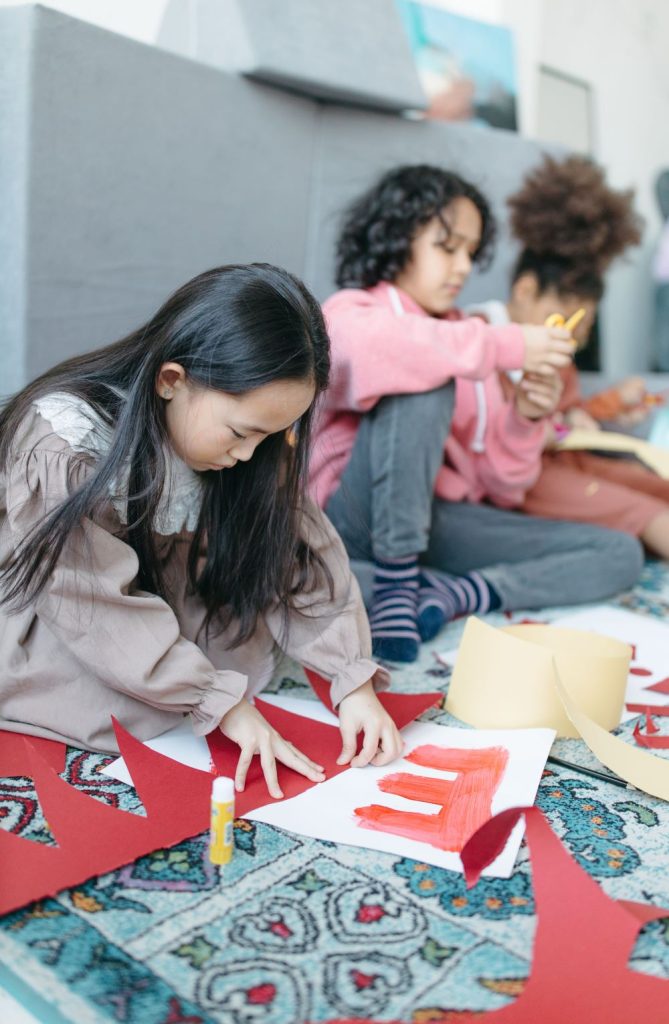
Photo courtesy of Anastasia Shuraeva via Pexels
7. Create a private space for a child to play and explore creatively e.g. a journal, scrapbook, diary with a lock and key, etc. A child can create multiple files online or save mental wanderings under “Notes” on an iPhone — but are these devices shared with others? Are they truly private? A child has a greater sense of ownership over ideas, sketches, or stories if they appear in a place recognized as uniquely theirs, with their name on it. Encourage children to keep a notepad next to their bed, where they can jot down ideas or dreams as they appear. Later, they can easily transfer these onto, or explore them further on, their computer.
8. Support a child’s creation of handmade letters and cards and save their language skills. Today’s children are raised to communicate on keyboards and key pads, using acronyms, emojis, abbreviations, and quickie colloquialisms. Will cursive writing become a lost art? Let’s not lose longhand writing, complete sentences, and correct punctuation. To creatively reach others, people need to know how to communicate well. Inspire children to write letters and send them snail mail to grandparents or others who will appreciate this “nostalgic” form of writing. Do not support an overdependence on technology.
9. Ensure that your child has right-brain friends who will encourage, support, and understand their imaginative and perhaps unconventional points of view. A creative child is one who does not feel shut down emotionally, who sees their ideas as valid, is open minded, and can connect with others. We all need help with self-acceptance but seeking emotional support from an AI chatbot is not the answer. This removes the sensitivity, nuance, flexibility and empathy or understanding found within a true, human-to-human interaction. A safe, non-judgmental atmosphere, both at home and at school, is important for creative self-expression.
10. Encourage a child’s unstructured play outdoors and deep sense of connection to, and curiosity about, nature in all its forms. Too many children today stay glued to their digital tools, mesmerized for hours by some violent video game or passively consuming AI slop. This not only cuts them off from their environment but gives them a skewed version of so-called reality. Creativity comes from a sense of openness and connectedness, not mind-numbing blinking at a screen, devouring others’ images and fears.
Even watching nature videos is no replacement for direct, tactile contact with the outdoors. Children need to feel and hear the wind, understand the power and beauty of wilderness, and understand their connectedness to All That Is. This will heighten their creative minds as active participants in the natural world, not passive observers. Sensory, hands-on outdoor learning allows children to witness first-hand the ebb and flow of life, whether it’s learning about an insect’s life cycles, marvelling over a butterfly, or discovering mindfulness through silence and quiet meditation.
After any of these activities, inspire children to write about, draw, or discuss their experiences. Author Joseph Cornell has some excellent related books, which include helpful exercises, such as Sharing Nature with Children and Sharing the Joy of Nature.

Photo courtesy of Sandi Yudha via Pexels
I grew up in Toronto, Canada, my backyard overlooking Lake Ontario. As kids, my best friend and I spent many happy hours playing by ourselves down at the lake. This helped me develop an early love of, and appreciation for, nature and an expanded sense of the world. I would gaze out across the water at the horizon, imagining that it might drop off or take me to unknown places. I climbed large rocks below our backyard, scaled our shale cliffs, clinging to exposed tree roots, picturing myself as an adventurer or explorer like the ones I read about. Crouching in the shallows, I discovered tiny crayfish fluttering in the water and watched smelts dash past as silver glints in the sun. We swam in the lake, learned to skip stones across it, and saw and felt the impact of smashing waves and spray during storms.
These activities enriched my aliveness, opening me to a sense of infinite creative possibilities. How much smaller my world would have been if it had focused, instead, on tiny, digital screens that cut me off from my real-life surroundings.
As the technological world gets more complicated and oriented to “you must use screens and AI to survive,” remember the value and power of simplicity. For instance, as kids, my best friend and I spent many happy days playing inside what we called “the super-duper house.” This large cardboard box, about 1.8 by 1.2 metres, had contained a horizontal freezer purchased by my parents. We dragged it into my backyard, opened both ends, and lay inside it horizontally, rolling onto its sides. As we moved right and left, the sides collapsed under our weight, then rolled up again. It was our own flexible, portable house that we created. We even cut out windows for it and added kitchen J-cloths as curtains. Sheer, simple fun, with no need for AI memes, electronic gadgets, plug-ins, or apps.
Although we are all now part of the global village, remember the warnings of Canadian media theorist Marshall McLuhan, who coined the phrase “The medium is the message” back in 1964. Even long before the Internet and AI, he argued that any medium itself matters more than content because just using the medium alters behaviour. It changes the way we think, demanding different levels of human engagement. For example, it takes sustained, deep focus to read a physical book. If a child, instead, scrolls through quick-hit images, videos and stories, this conditions their brain to seek quick gratification and reinforces fragmented thinking.
In contrast, I support the cultural philosophy known as the “slow movement,” which supports a shift away from “fastest is always better” approach. To be truly creative in today’s world, I believe that children need to use AI only sparingly and with adult supervision. Ideally, parents and teachers can promote learning that prioritizes mindfulness, sustainability and presence, in every aspect of life. But first, adults need to model this way of being themselves.
